> For the complete documentation index, see [llms.txt](https://docs.probe.splx.ai/llms.txt). Markdown versions of documentation pages are available by appending `.md` to page URLs; this page is available as [Markdown](https://docs.probe.splx.ai/ai-asset-management/connect-environments.md).
# Connect Environments
AI Assets requires a connected environment before it can begin discovery.\
Once connected, AI Assets will scan, discover, and populate your AI inventory with **Models, AI Workflows, MCP Servers, Guardrails, and custom tools** found in your infrastructure.
## Add Your First Environment
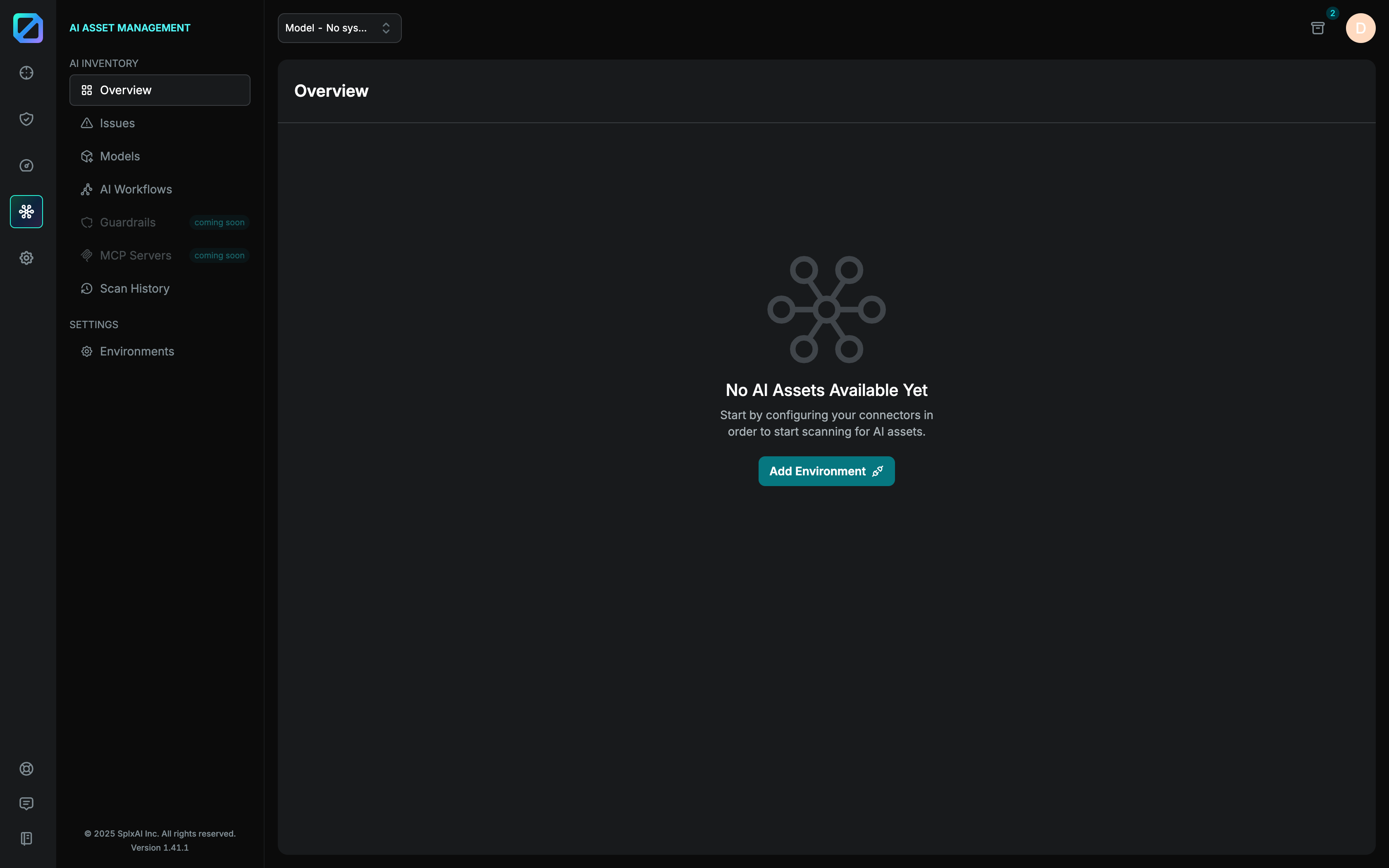
When no environments are connected, the AI Assets dashboard shows an **empty state**.\
Click **Add Environment** to start configuration.
Figure 1: Adding Your First Environment
### Step 1: Select Environment Type
Choose the type of environment you want to connect.\
Currently supported:
* **GitHub**
* **GitLab**
### Step 2: Configure Connection
Depending on the environment type, provide the required connection details:
#### GitHub
1. Select **GitHub**.
2. Enter:
* **Environment Name** – a descriptive label for the connection.
* **Description** – optional details for context.
* **Installation ID** – generated during the GitHub App installation. To get the ID:
* In the upper-right corner of GitHub, click your profile picture
* Click on **Organizations**.
* Go to **Applications** under the **Integrations**.
* Select your GitHub App and click **Configure**.
* Copy the `` part from the URL, which looks like this:
/settings/installations/\
* The `` is your **GitHub App Installation ID**.
For more details on installing the GitHub app visit the relevant [GitHub App installation documentation](https://docs.github.com/en/apps/using-github-apps/installing-a-github-app-from-a-third-party).
#### GitLab
1. Select **GitLab**.
2. Enter:
* **Environment Name** – a descriptive label for the connection.
* **Description** – optional details for context.
* **Personal Access Token** – a valid GitLab token with appropriate permissions:
* read\_api
* read\_repository
For more details visit the [GitLab Personal Access Tokens](https://docs.gitlab.com/user/profile/personal_access_tokens/?utm_source=chatgpt.com).
After filling out the details, click **Create** to complete the setup.
## Manage Environments
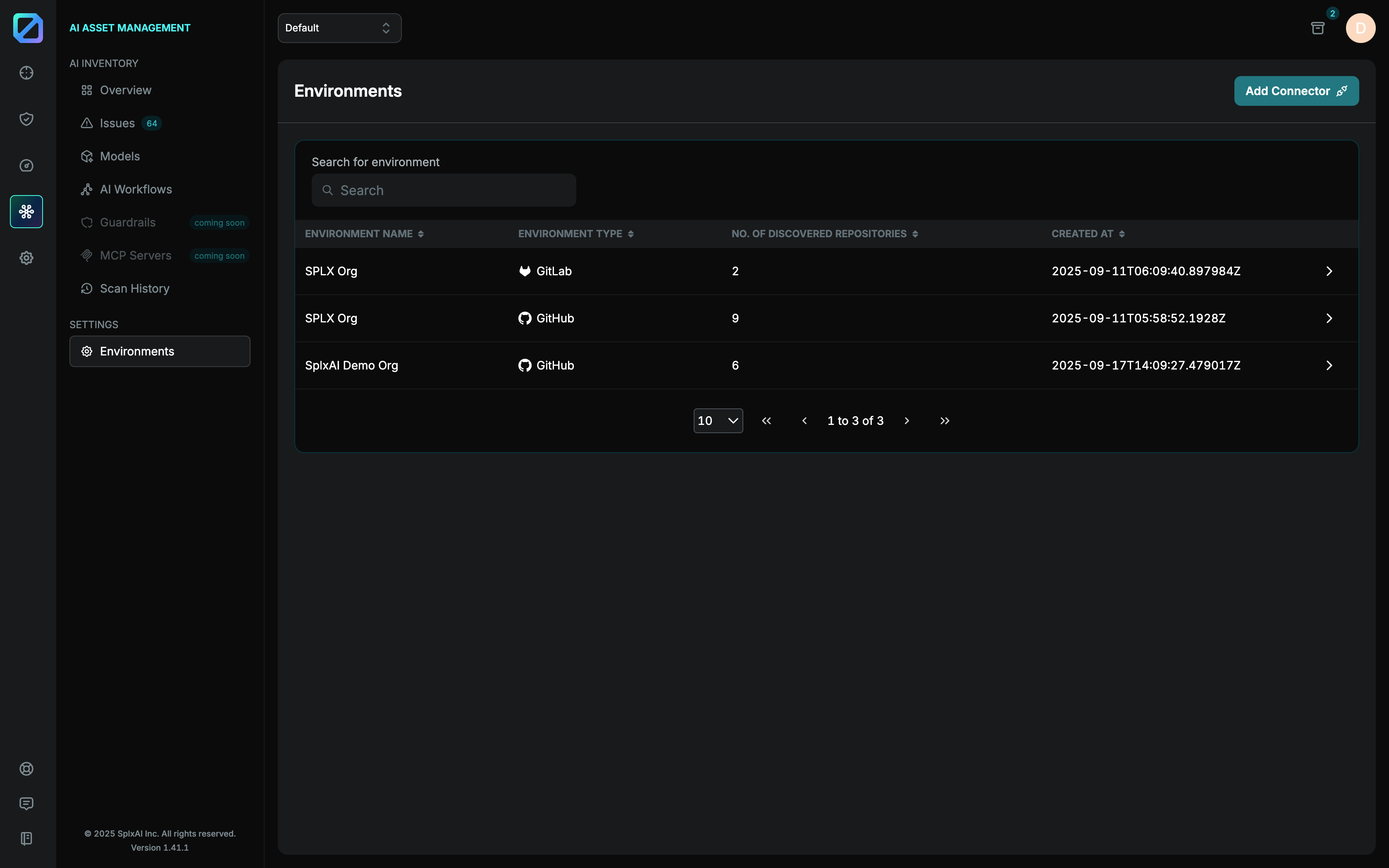
Once at least one environment is added, the **Environments page** lists all active connections, including:
* **Environment Name** – the given name of the environment.
* **Environment Type** – currently GitHub or GitLab.
* **No. of Discovered Repositories** – repositories scanned in that environment.
* **Created At** – when the environment was first connected.
From here you can manage existing environments or add new ones using **Add Connector**.
Figure 2: Environments Page
## Next Steps
Once your environment is connected, the [scans](/ai-asset-management/scan-for-ai-assets.md) can be triggered.
---
# Agent Instructions
This documentation is published with GitBook. GitBook is the documentation platform designed so that both humans and AI agents can read, navigate, and reason over technical content effectively. Learn more at gitbook.com.
## Querying This Documentation
If you need additional information that is not directly available in this page, you can query the documentation dynamically by asking a question.
Perform an HTTP GET request on the current page URL with the `ask` query parameter, and the optional `goal` query parameter:
```
GET https://docs.probe.splx.ai/ai-asset-management/connect-environments.md?ask=&goal=
```
`ask` is the immediate question: it should be specific, self-contained, and written in natural language.
`goal` is optional and describes the broader end goal you are ultimately trying to accomplish on behalf of the user. GitBook uses it to tailor the answer towards what is most useful for that goal.
The response will contain a direct answer to the question and relevant excerpts and sources from the documentation.
Use this mechanism when the answer is not explicitly present in the current page, you need clarification or additional context, or you want to retrieve related documentation sections.