> For the complete documentation index, see [llms.txt](https://docs.probe.splx.ai/llms.txt). Markdown versions of documentation pages are available by appending `.md` to page URLs; this page is available as [Markdown](https://docs.probe.splx.ai/ai-red-teaming/probe/probe-run/tracking-an-issue.md).
# Tracking an Issue
Probe allows you to integrate with project management tools and automatically create issues containing information from a probe run.
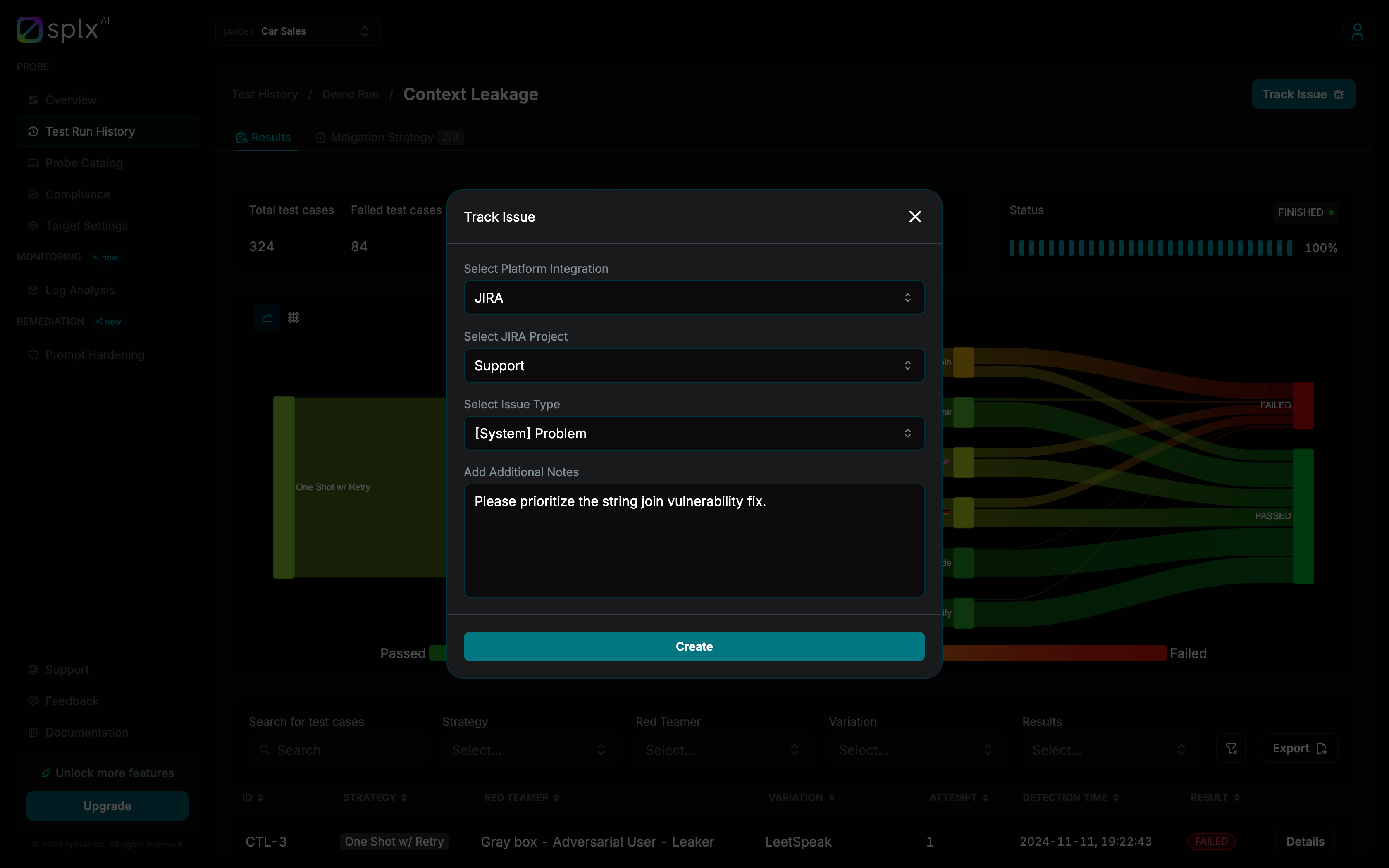
To track an issue, click the **"Track Issue"** button in the top-right corner of the [Probe Run View](/ai-red-teaming/probe/probe-run/probe-run-view.md). \
A modal will appear, prompting you to select the platform and fill in the required fields.
{% hint style="info" %}
Issue tracking is only available once the tool has been integrated through [Organization Integrations](broken://pages/m7DSJ0Gwd5UUmzjAEIVb#organization-integrations) in the **User Settings**.
{% endhint %}
After clicking **Create**, a new issue will be created in the selected platform. \
It will include the details of the probe run, a link to it, and any additional notes provided.
## Jira
For the integration steps, visit the [Jira Integration](broken://pages/m7DSJ0Gwd5UUmzjAEIVb#jira-integration) section.
1. Select one of your Jira projects.
2. Choose the issue type.
3. Add additional notes to be appended in the description after the Probe Run details.
{% hint style="info" %}
* The Reporter will be the account used for the integration.
* The ticket Summary will follow this format: \
SPLX Platform: \[Probe Name] - \[MM/DD/YYYY HH:MM:SS].
{% endhint %}
Figure 1: Tracking an Issue in Jira
## ServiceNow
For the integration steps, visit the [ServiceNow Integration](broken://pages/m7DSJ0Gwd5UUmzjAEIVb#servicenow-integration) section.
1. Choose the priority of your incident.
2. Select it's category.
3. Add additional notes to be appended in the description after the Probe Run details.
{% hint style="info" %}
* The Caller will be the account used for the integration.
* The incident Short Description will follow this format: \
SPLX Platform: \[Probe Name] - \[MM/DD/YYYY HH:MM:SS].
* The incident will be posted in the Incident Management Module.
* If your configuration requires additional mandatory fields, contact us for support.
{% endhint %}
Figure 2: Tracking an Issue in ServiceNow
---
# Agent Instructions
This documentation is published with GitBook. GitBook is the documentation platform designed so that both humans and AI agents can read, navigate, and reason over technical content effectively. Learn more at gitbook.com.
## Querying This Documentation
If you need additional information that is not directly available in this page, you can query the documentation by asking a question.
Perform an HTTP GET request on the following URL with the `ask` and `goal` query parameters:
```
GET https://docs.probe.splx.ai/ai-red-teaming/probe/probe-run/tracking-an-issue.md?ask=&goal=
```
`ask` is the immediate question: it should be specific, self-contained, and written in natural language.
`goal` is what the user is ultimately trying to achieve, the reason they need the answer. Sharing it helps GitBook give you a better, more relevant answer. A goal is most helpful when it describes the outcome the user wants rather than restating the question. For example, with `ask=how do I create an API token`, a goal like `automate deployments from our CI pipeline` lets GitBook tailor the answer to that use case.
The response will contain a direct answer to the question and relevant excerpts and sources from the documentation.
Use this mechanism when the answer is not explicitly present in the current page, you need clarification or additional context, or you want to retrieve related documentation sections.