> For the complete documentation index, see [llms.txt](https://docs.probe.splx.ai/llms.txt). Markdown versions of documentation pages are available by appending `.md` to page URLs; this page is available as [Markdown](https://docs.probe.splx.ai/settings/platform-settings/workspaces-settings/overview.md).
# Overview
## Workspaces Page
Navigate to the [**Workspaces Settings**](/settings/platform-settings/workspaces-settings.md) and select the **Overview** from the navigation bar on the left side of the page to manage your workspaces.
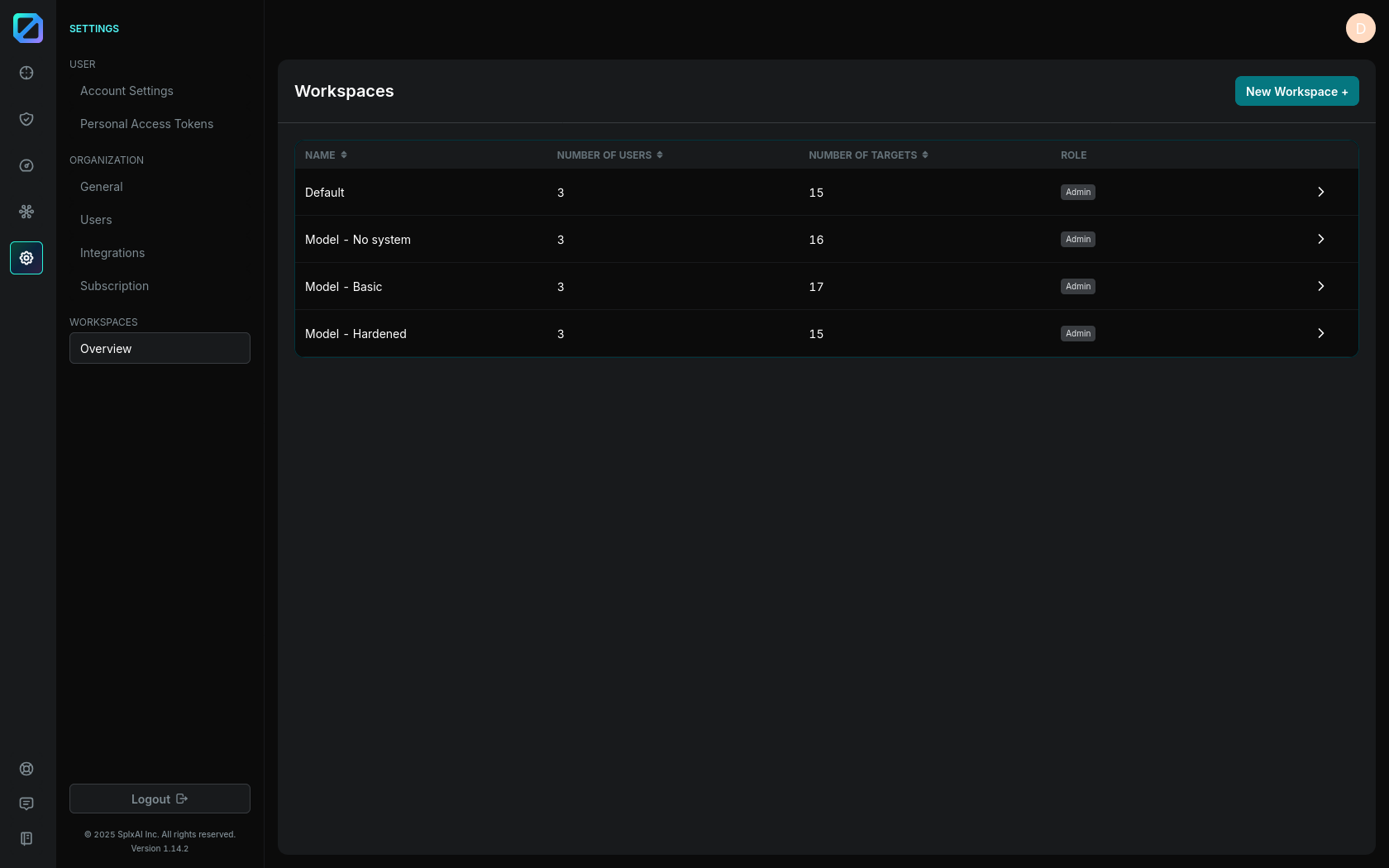
The Workspaces table provides a list of all workspaces in your organization. For each workspace, you can see its name, the number of users, the number of targets, and the role you have within that workspace.
From the Workspaces page, you can open any workspace to view or manage its details by clicking on it. You can also [create a new workspace](#create-a-new-workspace) using the **New Workspace +** button in the top-right corner.
Figure 1: Workspaces Settings Overview Page
### Create a New Workspace
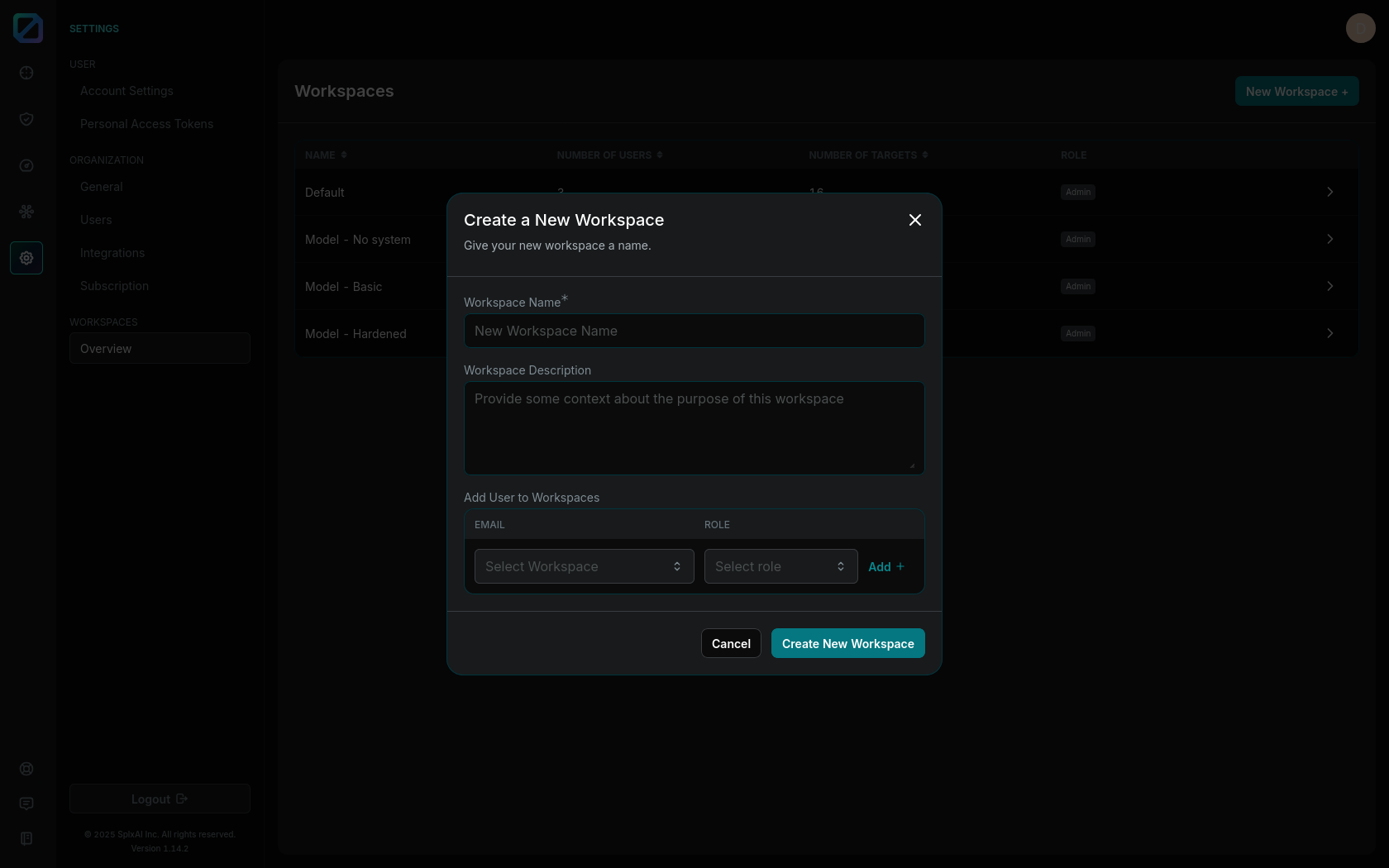
After clicking the **New Workspace +** button in the top-right corner, a creation form appears where you can define the initial details and users for the workspace. The form includes the following fields:
* **Workspace Name** - The name that will appear in the workspace list.
* **Workspace Description** - An optional summary describing the purpose or scope of the workspace.
* **User Email** - The email address of a user you want to add during workspace creation.
* **User Role** - The role assigned to that user within the workspace (**Admin**, **Member**, or **Viewer**).
{% hint style="info" %}
After entering the user’s email and selecting a role, click **Add +** to include them in the workspace.
{% endhint %}
Once all details are completed, click **Create New Workspace** to finalize the creation of the workspace.
Figure 2: Create a New Workspace Page
## Workspace Settings
Once you open a workspace, its dedicated page appears with a horizontal navigation bar that includes the following tabs: **Overview**, **Users**, and **Policies**.
### Overview
{% hint style="info" %}
The **Workspaces Overview** page and the **Workspace Overview** page (note the plural vs. singular) are different and serve distinct purposes. The plural version lists all workspaces in the organization, while the singular version displays details for an individual workspace.
{% endhint %}
The **Workspace Overview** page provides specifications for one particular Workspace in your organization. It displays **Workspace Name** and **Workspace Description**. Both can be edited and saved by clicking "**Save Changes**" button in the bottom-right corner.
{% hint style="danger" %}
Deleting a workspace permanently removes all associated targets, AI runtime protection policies, and AI inventories. This action is irreversible and should be performed with caution.
{% endhint %}
Figure 3: Workspace Overview Page
### Users
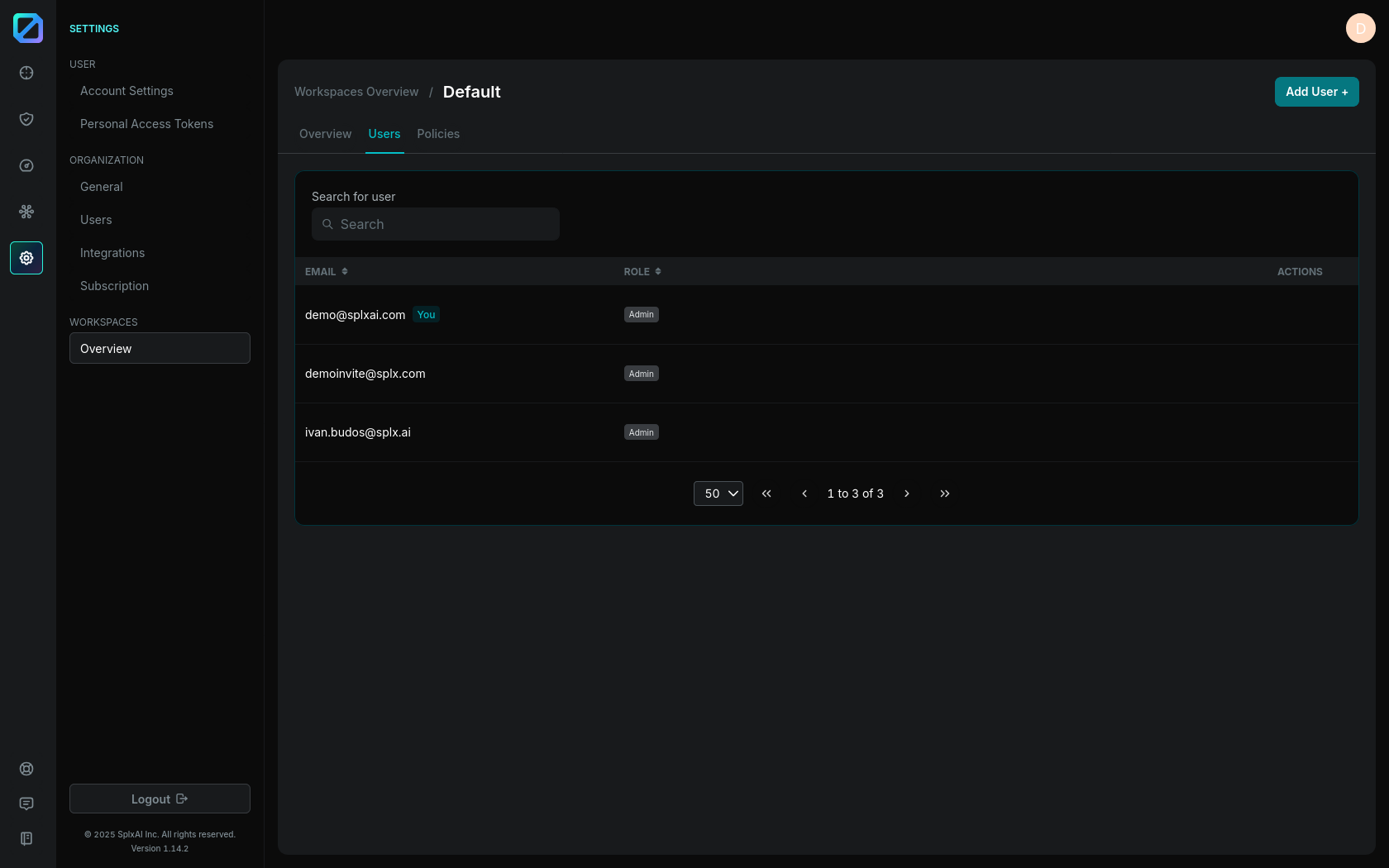
The **Workspace Users** page allows you to manage all members of your workspace. You can view a list of users, including their email addresses and assigned roles. The search bar helps you quickly find a specific user.
From here, you can [**Invite a New User to Workspace** ](/settings/platform-settings/workspaces-settings/overview.md#add-user-to-workspace) using the "Add user +" button, or manage existing users with available actions:
* Remove the user from the workspace.
* Change the user role.
{% hint style="info" %}
Only workspace **Admins** can invite new users, modify the roles and delete existing users.
{% endhint %}
Figure 5: Users overview for the chosen Workspace
#### Add New User to Workspace
To add a user to your workspace:
1. Ensure your organization has at least one other user besides yourself. If not, invite a new user to the organization first.
2. Click the **Add User +** button in the top-right corner to open the user addition form.
3. Enter the **User Email** and assign a **Workspace Role** (Admin, Member, or Viewer).
4. Click **Add User** to complete the process.
### Workspace Policies
This page allows you to manage all Custom Policies within a specific workspace, as well as create new ones. The available actions for policies in the selected workspace include:
* **Update Policy**
* **Export Policy**
* **Delete Policy**
To add a new Custom Policy, click the **Add Custom Policy +** button and [follow the instructions](/ai-red-teaming/probe/compliance.md#custom-policies-creation-page).
Figure 6: Workspace Policies Settings
---
# Agent Instructions
This documentation is published with GitBook. GitBook is the documentation platform designed so that both humans and AI agents can read, navigate, and reason over technical content effectively. Learn more at gitbook.com.
## Querying This Documentation
If you need additional information that is not directly available in this page, you can query the documentation dynamically by asking a question.
Perform an HTTP GET request on the current page URL with the `ask` query parameter, and the optional `goal` query parameter:
```
GET https://docs.probe.splx.ai/settings/platform-settings/workspaces-settings/overview.md?ask=&goal=
```
`ask` is the immediate question: it should be specific, self-contained, and written in natural language.
`goal` is optional and describes the broader end goal you are ultimately trying to accomplish on behalf of the user. GitBook uses it to tailor the answer towards what is most useful for that goal.
The response will contain a direct answer to the question and relevant excerpts and sources from the documentation.
Use this mechanism when the answer is not explicitly present in the current page, you need clarification or additional context, or you want to retrieve related documentation sections.